Wire size check
Sizing a wire looks like one table lookup, but it’s eight steps, and only one of them needs a number from your wiring rules. Here they are in order, worked through on one circuit. The app runs the same steps on yours.
- System
- single phase, 230 V
- Conductor
- 10 mm² copper, 70 °C
- Load
- 32 A, power factor 0.9
- Run
- 35 m one way
- Capacity from the book
- 50 A
- Ambient
- 40 °C, quoted at 30 °C
- Grouping
- 0.80
- Terminations
- 45 A
- Device
- 40 A
- Drop limit
- 3 %
Every figure here is made up for the example, including the 50 A. Real capacities come from your own copy of the wiring rules. This site doesn’t reproduce them.
The cable carries the load with 2.6 A to spare, but a 40 A breaker is too big for it, and one check couldn’t be made. A table lookup alone shows neither problem.
- okAdjustment for grouped conductors
Applied a factor of 0.800 as supplied.
- okTermination temperature limit
The conductor is the binding limit at 34.6 A; the terminations allow 45.0 A.
- not checkedContinuous load uplift
The load was treated as non-continuous, because no uplift factor was supplied. A load that runs for three hours or more is generally treated as continuous and carries an uplift from your rules.
- okConductor carries the design current
34.6 A usable against 32.0 A required, a margin of +2.6 A.
- noProtective device
A 40 A device does not protect a conductor good for only 34.6 A.
- okVoltage drop
4.24 V, 1.84 % against a limit of 3.00 %.
The calculation sheet, as the app writes it
The lookup is the easy bit
Everyone finds the right row in the table. The mistakes come after it: derates applied in the wrong order, forgetting that lower-rated terminations cap the result, missing the uplift on a continuous load, or picking a breaker that protects the cable but trips on the load. Those are all rules, not table values, and rules can be calculated.
The order matters
- Capacity at the conductor’s own temperature rating, from your code book.
- Ambient correction, worked out here as the square root of the ratio of the temperature headrooms. The correction tables in the codes are this same formula in five-degree steps, rounded, so using your actual ambient is more accurate.
- Grouping, if more current-carrying conductors share the raceway than the table assumes. The factors come in steps and can’t be derived, so you enter them.
- The termination limit. You can derate from a hotter column, but you can’t then draw more than the terminations are rated for. This is the step people skip most, and skipping it gives a cable that only passes on paper.
- The continuous-load uplift, applied to the load, not to the cable.
- The comparison: what the cable can carry against what the load needs.
- The breaker window: at least the design current, at most what the cable can carry.
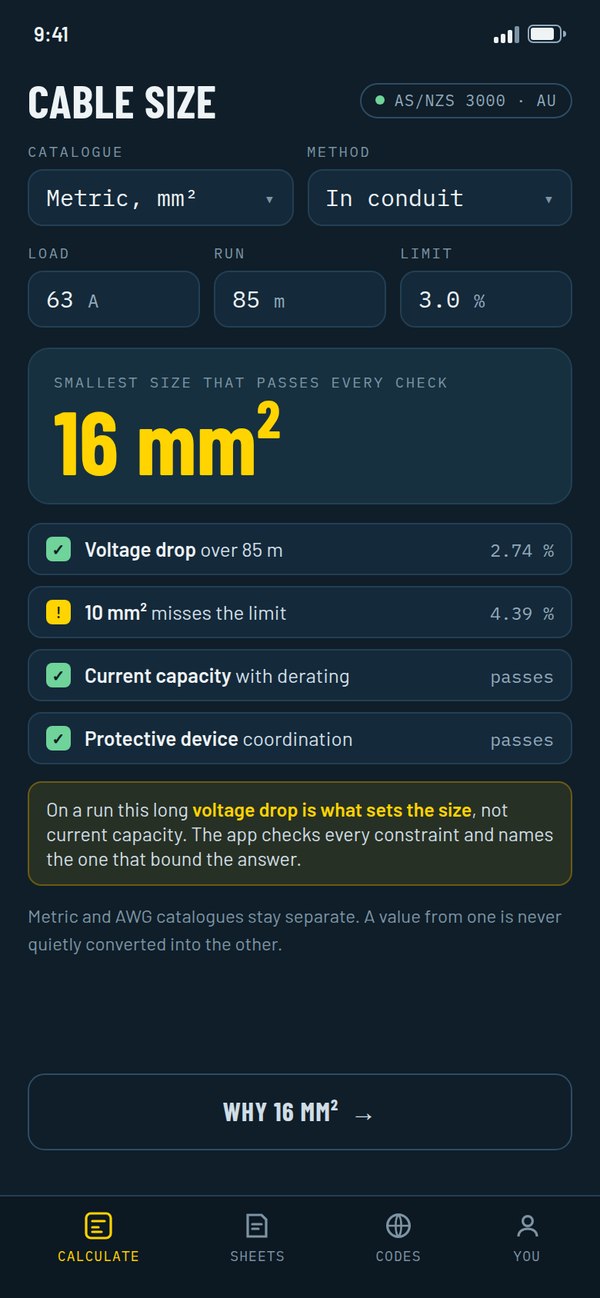
- Voltage drop, which doesn’t depend on any of the steps above and often decides the size on a long run.
A skipped check isn’t a pass
In the example above no continuous-load factor was given, and the result says so. It doesn’t just treat the load as non-continuous and carry on. The same goes for grouping, the terminations, the breaker and the drop limit. Calculators that fill in a default for something you didn’t enter are how wrong answers end up in front of an inspector.
Where the one number comes from
This site won’t tell you the capacity of a conductor. That figure is in your national wiring rules, it’s copyrighted, and it isn’t reproduced anywhere here. In the app, with a code pack, you pick your code and edition and the number comes from the pack, with the clause printed on the sheet. Without a pack, the app tells you which table and column to look in, and you type the figure from your own book. The other seven steps are the same either way.
Run it on your own circuits
In the app all of this is one screen, in your code, edition and units, offline, with every circuit saved to its job. The free calculators here each do one piece of it: voltage drop, the smallest size for a drop limit, conduit fill and Ohm’s law. See the app.
More free calculators
Voltage drop calculator →
Single phase, three phase and DC, in mm², AWG or kcmil. Shows every step and gives you a sheet to print.
Wire size by voltage drop →
The smallest size that keeps the drop under your limit, plus a list of what it doesn’t check.
Ohm’s law and power →
Volts, amps or ohms from the other two, plus real power for single and three phase.
Wire gauge chart →
AWG and kcmil sizes with diameter, mm², circular mils and resistance, worked out from the gauge formula.
Conduit fill →
How full your conduit is, for any conduit and any cable, in mm or inches, against the limit from your rules.
Fishtape does the rest
Current capacity with derating, for your code and edition. Short circuit, protective conductor, transformer fault current and conduit fill. Sheets saved by job, and all of it works offline. Leave your email and we’ll send the link.
€1.99 a month, or €29.99 once, for everything. Free for 7 days.
Get it on launch day
We’ll send one email when it’s out. Tell us which code you work to and that pack moves up the list.