Wire sizing step by step, on one circuit →
Ohm’s law and power
Enter any two of voltage, current and resistance to get the third, plus real power for single and three phase. Volts, amps, ohms and watts, with every step written out.
The calculation sheet
Ohm’s law in its three forms
One formula, rearranged three ways. Use the one that matches the two values you have:
I = V / R
R = V / I
Voltage in volts, current in amps, resistance in ohms. It holds for a resistive load at a steady voltage. It doesn’t hold for a load whose resistance changes as it heats up during the measurement, for semiconductors, or where current and voltage are out of step. That last case is where power factor comes in.
Real power in watts, and where √3 comes from
For a single phase load, real power is voltage times current times the cosine of the angle between them:
For a balanced three phase load, with the voltage measured line to line:
√3 is 1.732, not 3. It’s there because the three phases are 120 degrees apart, so they add as vectors, and the same factor shows up in the three phase voltage drop formula for the same reason.
A worked example
A 230 V single phase load drawing 10 A at unity power factor: 230 × 10 × 1 = 2300 W. The same 10 A on a 400 V three phase supply at unity: 1.732 × 400 × 10 = 6928 W. At power factor 0.85 the three phase figure drops to 5889 W, but the current, and the heat in the cable, stay the same. That’s why power factor correction pays.
Apparent power, reactive power and the power triangle
Apparent power, in volt-amperes, is what the cable and the breaker see: V × I for single phase, √3 × VLL × I for three phase, with no power factor in it. Real power, in watts, is the part that does work. Reactive power, in volt-amperes reactive, flows back and forth and does no work.
They form a right triangle: S² = P² + Q², and cosφ = P / S. At a power factor of 0.8, a load drawing 10 kVA does 8 kW of work, but the cable still carries the full current. That’s why cables and breakers are sized on current, not on watts.
Watts, kilowatts and horsepower
A kilowatt is 1000 watts. One mechanical horsepower is 745.7 W. To get the electrical input from a nameplate in horsepower, multiply by 745.7 and divide by the motor efficiency. A 5 hp motor at 88 % efficiency draws about 4237 W, not 3729 W.
What this page won’t tell you
What size wire to run, or what the breaker should be. That depends on current-carrying capacity, derating for ambient temperature, grouping and installation method, and the rules where you work. Those come from national wiring rules, which are copyrighted, so none of that is here. Once you know the current, the wire size calculator gives you the smallest size for voltage drop. That’s one check out of several.
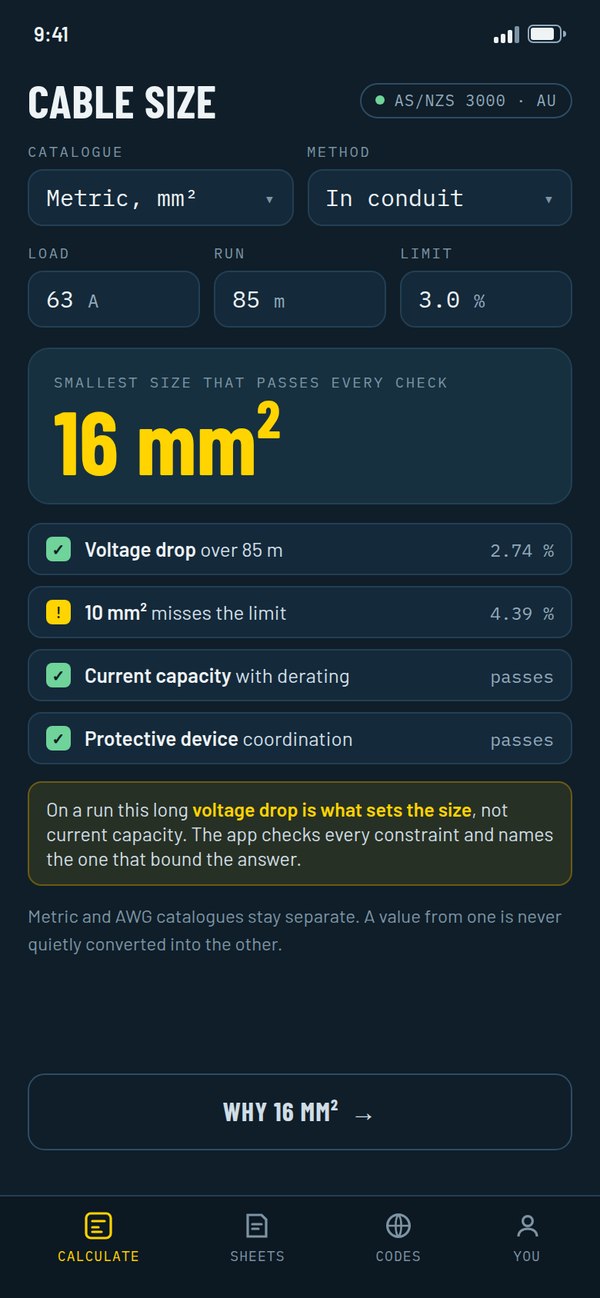
The app does the rest: current capacity with derating, breaker checks, your code and edition, and one answer that tells you which check decided it. See the app.
More free calculators
Voltage drop calculator →
Single phase, three phase and DC, in mm², AWG or kcmil. Shows every step and gives you a sheet to print.
Wire size by voltage drop →
The smallest size that keeps the drop under your limit, plus a list of what it doesn’t check.
Wire gauge chart →
AWG and kcmil sizes with diameter, mm², circular mils and resistance, worked out from the gauge formula.
Conduit fill →
How full your conduit is, for any conduit and any cable, in mm or inches, against the limit from your rules.
Fishtape does the rest
Current capacity with derating, for your code and edition. Short circuit, protective conductor, transformer fault current and conduit fill. Sheets saved by job, and all of it works offline. Leave your email and we’ll send the link.
€1.99 a month, or €29.99 once, for everything. Free for 7 days.
Get it on launch day
We’ll send one email when it’s out. Tell us which code you work to and that pack moves up the list.