Voltage drop · Cable size · Maximum demand · Earthing
Every number,
with its working.
Fishtape is the calculation app for licensed electricians. It sizes the conductor, checks it against every constraint your code puts on it, and hands you a sheet that shows exactly how it got there. On site, with no signal, in the edition you actually work to.
Not out yet. Leave your email and you get the link the day it lands, plus the pack for your code first.
What it does that the free ones do not
There is no shortage of apps that show a number. The number is the easy part. Everything below is the part that matters when someone asks you to justify it.
It shows its work, line by line
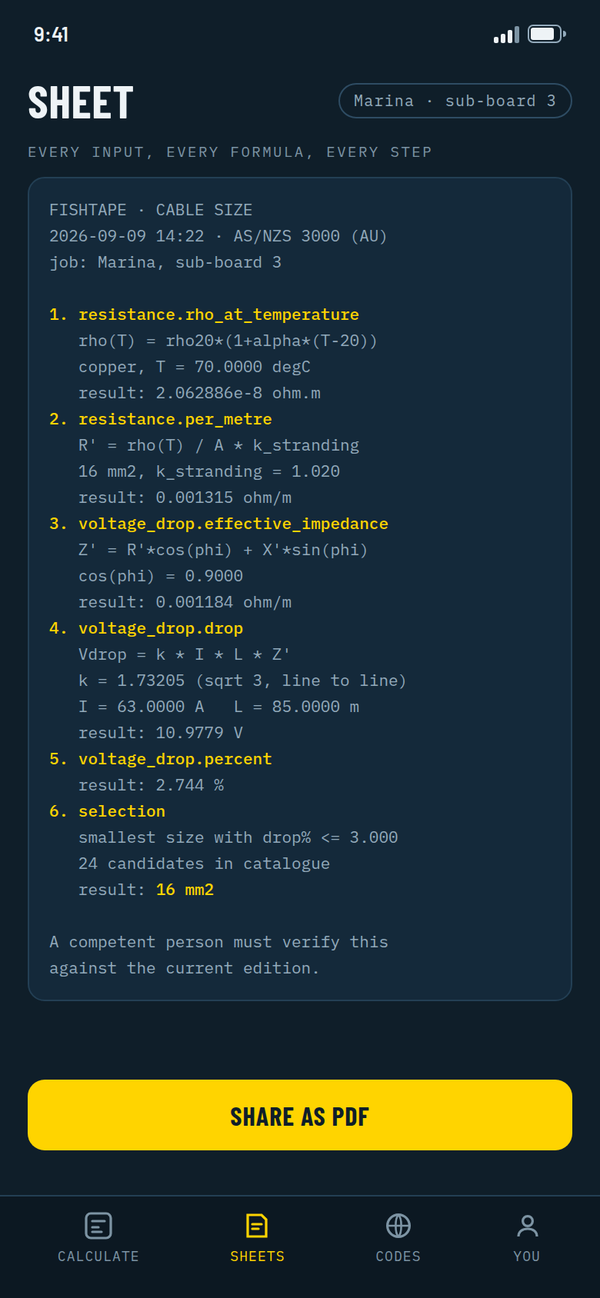
Every result comes with a sheet naming the formula used at each step and the value of every input that went into it. Export it as a PDF, attach it to your paperwork, send it to the engineer who asked. It is a record of what you calculated and how, not a claim that the installation complies.
This is the whole reason the app exists. A number with no working is worth nothing the moment an inspector asks where it came from.
It answers with a size, not with one check
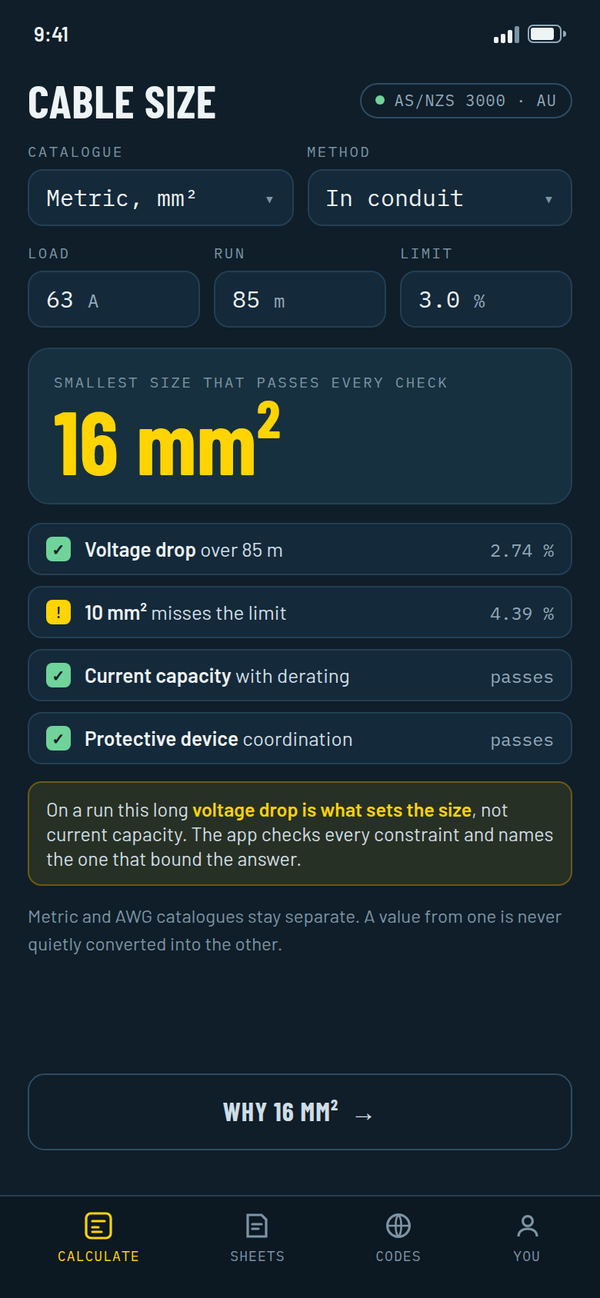
A conductor has to satisfy several things at once: current capacity after derating for grouping, ambient temperature and installation method; the voltage drop over the run; coordination with the protective device. Any one of them can be the one that decides.
Fishtape resolves all of them, returns the smallest size that passes every check, and tells you which constraint was binding. On long runs that is usually voltage drop. In a hot roof space full of circuits it usually is not. Knowing which is the difference between a size you can defend and a guess.
The edition in force where you work
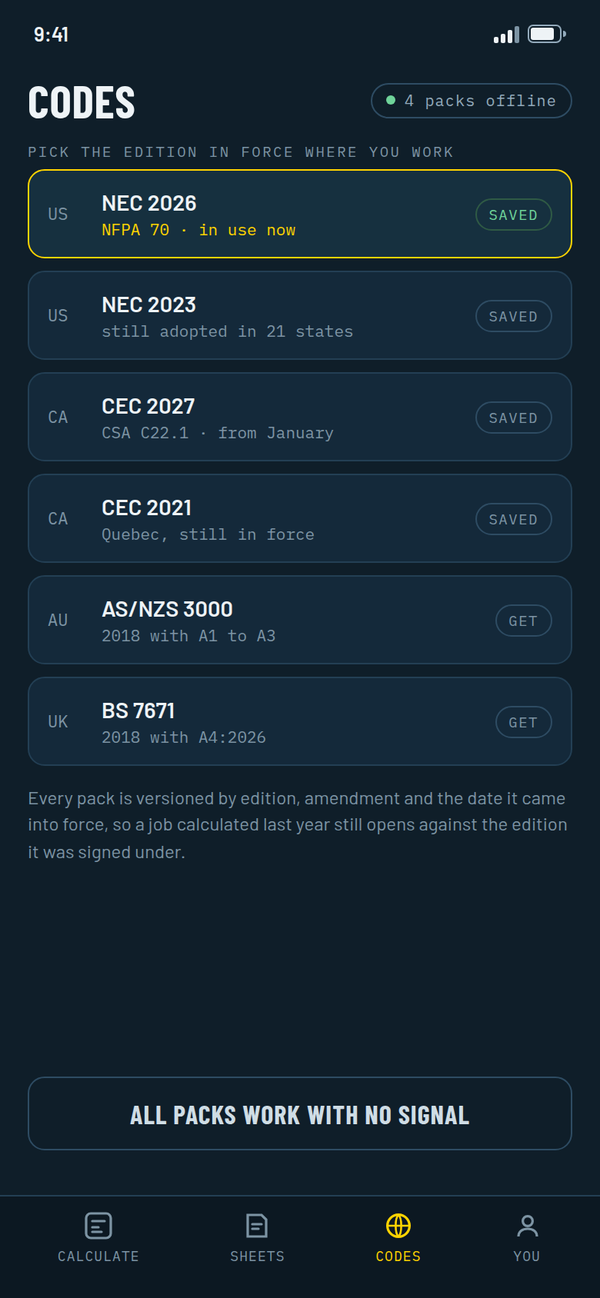
Codes move and jurisdictions move at different speeds. NEC 2026 is out while many states still enforce 2023. The Canadian code publishes a 2027 edition in January while Quebec works to 2021. Fishtape holds each edition as its own pack, versioned by amendment and by the date it came into force.
So you pick the edition you are actually working to, and a job you calculated last year still opens against the edition it was signed under. Packs download for offline use, because plant rooms and basements do not have signal.
No AI. Ever. Anywhere near the arithmetic.
Deterministic
The same inputs give the same answer every time. No language model sits in the calculation path and none is planned. A confidently wrong number about conductor sizing is a safety problem, not a rough edge.
Proven, not asserted
One core, written once in Rust, used unchanged on iOS, Android and web, so platforms cannot disagree. Tested with a golden corpus, property tests, and mutation testing: 169 mutants killed, none survived.
It refuses rather than guesses
A calculation that falls outside the tabulated range returns an explicit error instead of an extrapolated number. Metric and AWG catalogues stay separate, so a value from one is never quietly converted into the other.
What is in it, and what it costs
In the first release
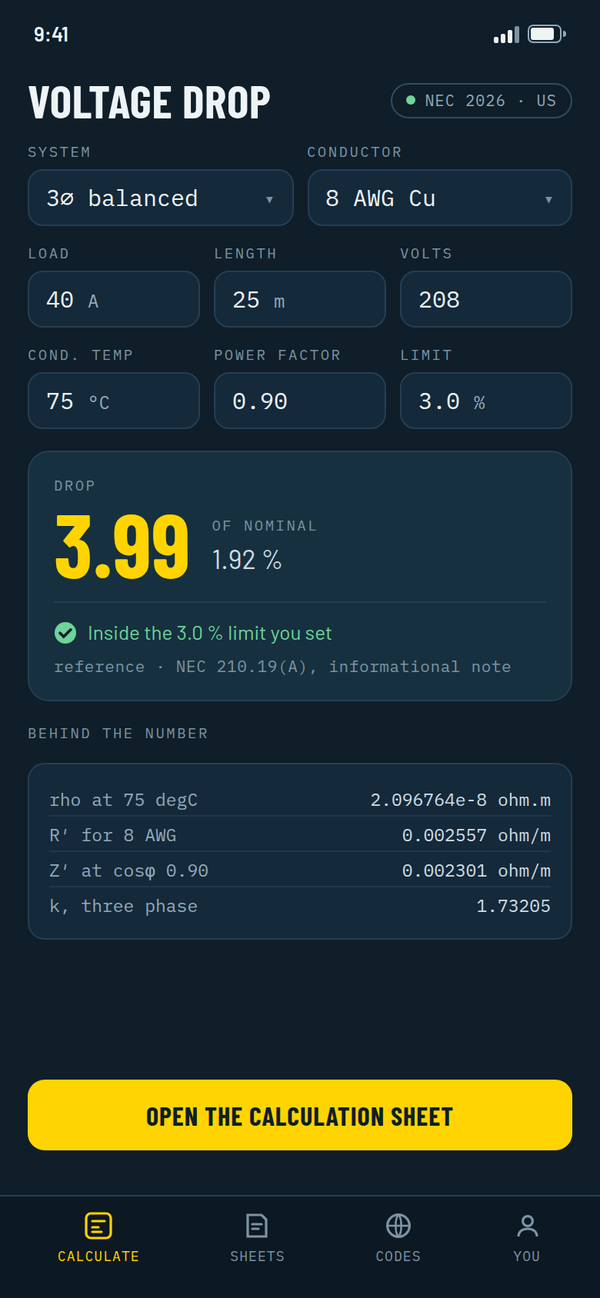
- Voltage drop: single phase, three phase and d.c., with conductor temperature, stranding and reactance
- Conductor sizing against every constraint, with the binding one named
- Current capacity with derating for grouping, ambient temperature and installation method
- Maximum demand and earthing conductor sizing
- Conduit and tubing fill
- Calculation sheets, saved per job, exported as PDF
- Metric, AWG and kcmil catalogues
- Offline packs per code and edition
One subscription, all platforms, all the packs you need. No advertising. Nothing sold on about you or about the jobs you calculate.
Roughly the price of one hour on site, once a year. Get the first build.
Try the engine before the app ships
Two of the calculations run free in your browser, on the same code that runs in the app. They are the part that needs no licensed data, so we can give them away: pure physics, computed exactly, with the full sheet. The rest of the list above needs the code packs, and that is what the app is.
Get the first build
One email, when it ships. Tell us which code you work to and we will build that pack sooner.