Wire sizing step by step, on one circuit →
Conduit fill calculator
How much of a conduit your cables take up. Any conduit, any cable, in millimetres or inches, with the working shown. You enter the bore and the cable diameters, and nothing here comes from anyone’s tables.
Cables in the conduit: group identical ones together
The calculation sheet
What this page knows and what it doesn’t
It knows geometry: the area of each circle, the total, and the ratio between them:
fill % = ΣAcables / Aconduit × 100
It doesn’t know how full you’re allowed to fill the conduit. That limit is in national wiring rules, which are copyrighted, and it depends on where you work and how many cables are in the run. So you enter it. Type the figure from your rules and the line under the result compares the two. Leave it blank and you just get the numbers.
It also doesn’t have the inside areas for each trade size, which are in the same tables. Use the bore from the manufacturer’s data for the conduit you’re installing, or the figure for that size in your own copy of the rules.
Trade size isn’t the bore
This is the easiest way to get the answer wrong. A conduit called 3/4 inch or 20 mm isn’t 3/4 inch or 20 mm inside. The trade size is a name, not a measurement. The real inside diameter depends on the type and the wall thickness, so rigid, intermediate, thin-wall and flexible conduit all differ at the same trade size. Measure it, or take it from the manufacturer’s data or the table in your rules. Not from the label.
Add areas, never diameters
Three 8 mm cables don’t need a 24 mm conduit. Area goes with the square of the diameter: the three cables come to 150.8 mm², a 25 mm bore is 490.9 mm², so they fill it to 30.7 %. Adding diameters gives you a meaningless number. That’s why the calculator asks for a count and a diameter for each kind of cable, not a total.
A worked example
Nine cables in one run: six of 5.1 mm, two of 8.9 mm and one of 14.2 mm, in a 54.5 mm bore. The six come to 122.6 mm², the two to 124.4 mm² and the single one to 158.4 mm², so 405.4 mm² in total against 2332.8 mm² for the conduit. That’s 17.4 %.
Why the limit depends on the number of cables
Wiring rules usually allow a different fill for one cable, for two, and for three or more, and there’s a physical reason. One cable can take up a big share of the bore and still pull, because it lies along the middle. Two tend to sit side by side and can jam against the wall. Three or more pack with gaps between them, so less of the space is usable. The calculator shows the cable count because the count decides which limit applies, and it’s easy to miscount.
Being under the limit doesn’t mean the pull will go
Fill is one check. The others aren’t geometry:
- Jamming. Three cables of similar size in a conduit only a little wider than they need can lock against each other and the wall partway along the run. It happens at certain ratios of bore to cable diameter, on straight runs as well as bends.
- Pulling tension and sidewall pressure. Both go up with length and with every bend. A short run at a high fill can be easier to pull than a long one at a low fill.
- Heat. Cables bundled in a conduit run hotter than in free air. That’s a current capacity question, and the derating rules in your code decide it.
- Room for later. A conduit filled right to the limit today has no room for another circuit tomorrow.
What the app adds
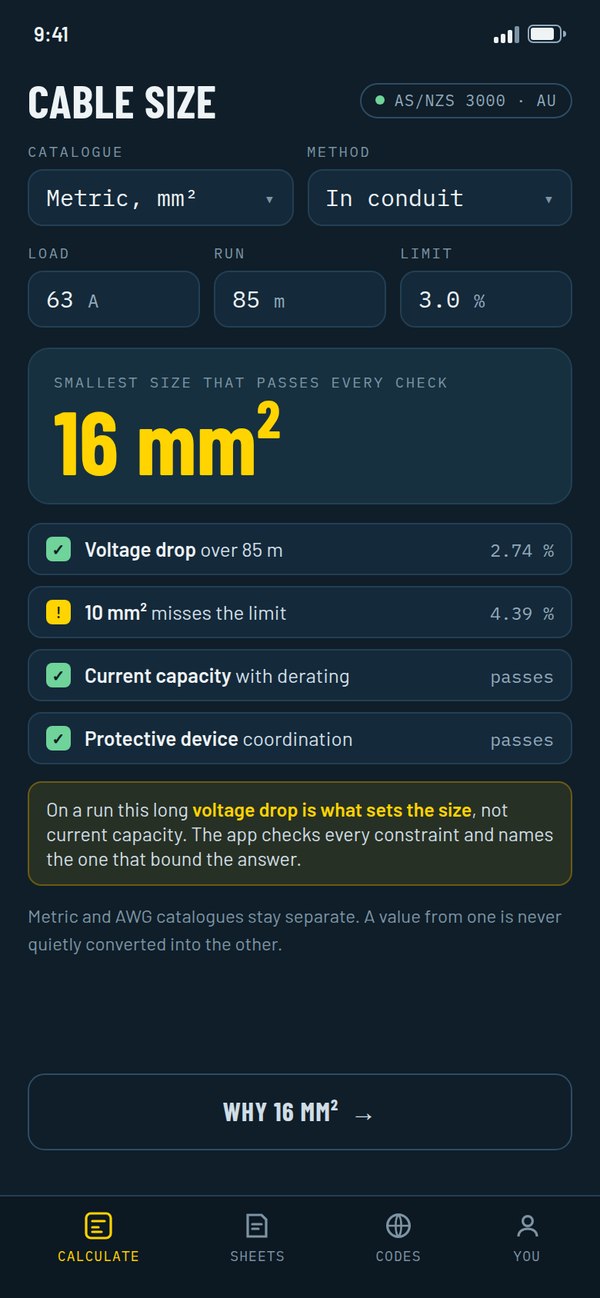
With a code pack, the tables: inside areas by trade size and type, cable diameters, and the fill limits for your code and edition, so you pick a conduit from a list instead of looking numbers up. The app also works out current capacity with derating for the same bundle, which is usually what decides things once the fill is comfortable. See the app.
More free calculators
Voltage drop calculator →
Single phase, three phase and DC, in mm², AWG or kcmil. Shows every step and gives you a sheet to print.
Wire size by voltage drop →
The smallest size that keeps the drop under your limit, plus a list of what it doesn’t check.
Ohm’s law and power →
Volts, amps or ohms from the other two, plus real power for single and three phase.
Wire gauge chart →
AWG and kcmil sizes with diameter, mm², circular mils and resistance, worked out from the gauge formula.
Fishtape does the rest
Current capacity with derating, for your code and edition. Short circuit, protective conductor, transformer fault current and conduit fill. Sheets saved by job, and all of it works offline. Leave your email and we’ll send the link.
€1.99 a month, or €29.99 once, for everything. Free for 7 days.
Get it on launch day
We’ll send one email when it’s out. Tell us which code you work to and that pack moves up the list.